“The role of overseas Vietnamese scientists is not only to transfer technical knowledge, but more importantly to transfer academic culture and international standards.” — Prof. Vinh Nguyen, UNSW Sydney
Prof. Nguyen Thanh Vinh known as Vinh Nguyen is a Vietnamese scholar in synthetic organic chemistry and currently leads a research group at the University of New South Wales (UNSW), Sydney. In 2026, he was recognised among the Top 250 Researchers in Australia, as published by The Australian.
As part of its academic networking activities, VASEA conducted a short interview with Prof. Vinh Nguyen to explore his perspectives on the contemporary research landscape, with particular attention to Vietnam’s scientific development and the future potential of Vietnam–Australia research collaboration.
Discussing the challenges facing Vietnamese science, Prof. Nguyen emphasised that the most significant constraints lie not in human capacity, but in the research ecosystem and supporting infrastructure. Experimental organic chemistry, in particular, depends heavily on access to advanced analytical facilities—such as high-field nuclear magnetic resonance (NMR) spectrometers, high-resolution mass spectrometry (HRMS), and automated purification systems—which remain limited or difficult to maintain in Vietnam. He further noted that funding mechanisms for fundamental research would benefit from greater flexibility, with an increased tolerance for scientific risk and a stronger emphasis on research quality rather than publication volume. In this context, the development of a critical mass of strong, independent, and sustainable research groups was identified as essential for Vietnam to establish distinctive research “schools” within the global scientific community.
From an international perspective, Prof. Nguyen highlighted the considerable untapped potential of Vietnam–Australia scientific cooperation. While existing collaborations have primarily focused on postgraduate training and capacity building, he argued that future progress would require more structured and long-term collaborative frameworks. In particular, he pointed to the value of Joint Laboratories and joint-supervision models, which can support sustained research programs, facilitate deeper academic exchange, and generate outcomes of shared relevance to both countries.
Below is the VASEA interview with Professor Vinh Nguyen.
Building a Sustainable Research Ecosystem: Perspectives from Prof. Vinh Nguyen, UNSW Sydney
1. Professor Vinh Nguyen, could you please share your views on how the collaboration between Australia and Vietnam in the field of Organic Chemistry is progressing?
At present, cooperation between the two countries primarily occurs in the training of highly qualified personnel within independent research groups, rather than through a systematic or coordinated framework. Scholarship programs from the Australian Government (such as AAS) and research projects funded by the Australian Research Council (ARC) have helped train a strong cohort of Vietnamese PhD and Master’s graduates. However, large-scale bilateral research collaborations—especially those involving pharmaceutical or materials science companies—remain quite limited.
We are seeing some initiatives to strengthen connections between major Australian universities such as the University of Sydney (Usyd), UNSW, UTS, and ANU, and universities and research institutes in Vietnam. Nevertheless, most of these collaborations still rely heavily on the personal efforts of individual professors. To achieve a real breakthrough, we need to move toward establishing Joint Laboratories or Bilateral Research Funds, which would enable long-term, highly applied research projects that can create meaningful impact in both markets.
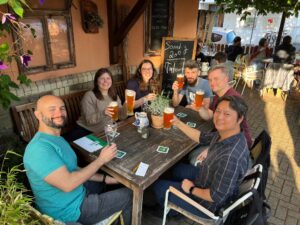
Prof Vinh with colleagues
2. Could you please share what scientific barriers Vietnam needs to overcome in order to elevate its position in the field of Organic Chemistry?
The biggest barrier does not lie in human capability or mindset, but rather in the research ecosystem and infrastructure. Experimental organic chemistry requires modern analytical instruments such as high-field nuclear magnetic resonance (NMR) spectrometers, high-resolution mass spectrometry (HRMS) systems, and automated purification platforms. The lack of these instruments—or the difficulty of maintaining them—in Vietnam slows down the process of validating scientific hypotheses.
In addition, the financial mechanisms for fundamental research need to be renewed in a more flexible direction—one that accepts risk and prioritizes quality over the number of publications. Building a sufficiently large community of strong research groups (a critical mass) with continuity and high independence is also essential. This would enable Vietnam to establish distinct research “schools” on the global scientific map, rather than remaining limited to theoretical or outsourced academic work.
3. Could you share your view on the role of overseas Vietnamese scientists in elevating the national scientific standing?
I see Vietnamese scientists abroad as both “gatekeepers” and “connectors”. Their role is not limited to transferring technical knowledge; more importantly, they help transfer academic culture and international standards.
Through activities such as independent peer review, supervising Vietnamese students, and participating in strategic advisory work, they help domestic science move more quickly toward meeting the world’s rigorous benchmarks. The success of Vietnamese intellectuals at leading universities in Australia, the United States, and Europe also contributes to building a “national intellectual brand”, thereby attracting more international investment and giving domestic scientists greater confidence in Vietnam’s ability to integrate and compete fairly on the global stage.
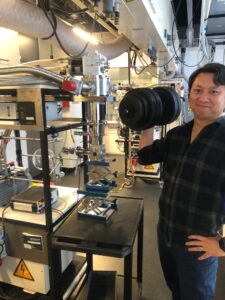
Prof Vinh in lab
4. Do you have plans to support or mentor young Vietnamese researchers in entering the field of Organic Chemistry?
This is my top priority in the coming years. In my research group at UNSW, I always give preference to hosting talented researchers and students from Vietnam for internships or PhD programs.
In the future, I plan to implement a joint-supervision model, which will allow young researchers in Vietnam to conduct part of their research projects in Australia, and vice versa. In addition, I hope to collaborate with organizations such as VASEA in Australia or VinUni in Vietnam to organize advanced lecture series or online thematic workshops to update students in Vietnam on the latest trends in Organic Chemistry. This support will focus on developing independent thinking and international publication skills—the key factors that enable young scientists to thrive in today’s highly competitive research environment.
About Prof. Vinh Nguyen
Professor Vinh Nguyen—also known in academic publications as Thanh Vinh Nguyen or Thanh V. Nguyen—was born in Vietnam and moved to Sydney, Australia after high school to study Industrial Chemistry at the University of New South Wales (UNSW). He later completed his PhD in Organic Chemistry at the Australian National University (ANU) under Professor Michael Sherburn.
His research focuses on synthetic organic chemistry, particularly the development of new synthetic methodologies and their applications in natural product synthesis. More broadly, his interests include designing and synthesizing complex organic molecules using innovative and efficient chemical transformations.
The Nguyen Group at UNSW works in the areas of synthetic methodology, organocatalysis, and related fields of modern organic chemistry, contributing to advances in efficient reaction design and molecular construction.
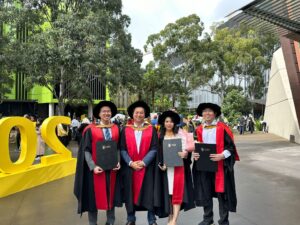
Prof Vinh and his Vietnamese colleagues graduated in 2024
