Genetic science is not merely a story confined to laboratories; it is the foundation of food security, of our capacity to adapt to climate change, and of sustainable development for Vietnam’s agricultural sector and the world at large.
Dear distinguished guests and VASEA members,
Today, Café with VASEA is honored to welcome Dr. Thuy Nguyen, a scientist in the fields of genetics and computational biology with extensive experience in the genetic improvement of aquaculture species and dairy cattle.
Dr. Thuy Nguyen has served as an advisor to several committees of the Food and Agriculture Organization of the United Nations (FAO) and was the first researcher to apply genomics to evaluate the genetic merit of climate-change adaptation traits in dairy cattle in Australia. She is currently a member of the Steering Committee of Interbull, the international organization for dairy cattle breeding, and is widely recognized for her experience in “translating science into value for the industry.”
Together, we will explore her journey, methodologies, and practical lessons in enhancing the genetic quality of livestock in the face of climate change challenges.
We will explore the journey, methodologies, and practical lessons in enhancing the genetic quality of livestock in the face of climate change challenges, summarized across the following six themes:
- The journey that led Dr. Thuy Nguyen to the fascinating intersection of genetics and computational biology
- Applying genetics and computational biology to breed dairy cattle adapted to climate change
- How to evaluate the economic impact and ROI of these breeding programs
- Encouraging farmers to translate research outcomes into on‑farm practice
- The potential of genomic selection technologies for aquaculture, particularly in the context of climate change
- Advice for those considering investment in genetics and breeding
~~~~~
Welcome, Dr. Thuy Nguyen. We sincerely thank you for accepting our invitation to join Café with VASEA.
The Journey That Brought Dr. Thuy Nguyen to the Intersection of Genetics and Computational Biology
Café with VASEA: Could you share the journey that led you to the fascinating intersection of genetics and computational biology?
Dr. Thuy Nguyen:
My love for genetics began in high school, when I was fortunate to be taught by an exceptionally inspiring teacher. She did more than impart knowledge—she ignited a spark within me, a flame that continued to burn until I chose genetics as the focus of my postgraduate studies and doctoral dissertation at Deakin University.
However, my journey did not follow a straight path. During my undergraduate studies in aquaculture at Nha Trang University, I happened to study computer science and programming purely out of personal interest, never imagining at the time that it had anything to do with shrimp or fish. Little did I know that, 25 years later, this very foundation would become a critical advantage when I entered the field of genomic selection research.
The real turning point came around 2009–2010, when next-generation sequencing technologies began to explode—coinciding with Australia’s initial adoption of genomics in dairy cattle breeding. Billions of DNA sequences were being decoded every day, but the question loomed large: who would analyze this massive volume of data? That question stayed with me and ultimately led me back to programming, into bioinformatics, and gradually deeper into quantitative genetics. It was then that I realized these two seemingly separate worlds—biology and computing—could, in fact, intersect in a remarkably powerful way.
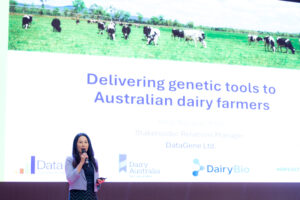
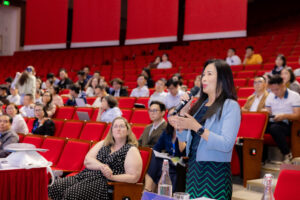
Dr. Thuy Nguyen at International Symposium on Applied Genomics in Agriculture (SAGA 2025) in Hanoi
Applying Genetics and Computational Biology to Select Dairy Cattle Adapted to Climate Change
Café with VASEA:
What a fascinating journey—from a high school classroom to genomic data—where seemingly random pieces fit together perfectly. With that foundation in place, you have applied it to a very concrete and timely problem: breeding dairy cattle that can adapt to climate change. Could you share more details about this project?
Dr. Thuy Nguyen:
Climate change is no longer a future scenario. The ten hottest years in recorded history have all occurred within the past decade. For the dairy industry, this has very tangible consequences: when temperature and humidity exceed certain thresholds, cows eat less, milk production declines, and overall health deteriorates. The question I posed was: can we use DNA to identify heat‑tolerant cows even before they start producing milk?
The first step was to define the trait. Ideally, we would measure the body temperature of each cow during hot days. However, with 1.3 million dairy cows in Australia, this is clearly not feasible at scale. Instead, we made use of existing data: milk yield, fat, and protein records that farmers routinely collect for each cow—usually monthly or every few months. By combining these data with hourly weather records from the Bureau of Meteorology stations near the farms, we were able to determine how much milk each cow produced on normal days and how much production declined on hot days.
From 14.6 million records of milk yield and quality spanning more than 15 years, we identified a clear threshold: milk production begins to decline when the average daily temperature exceeds 20°C and humidity reaches 45%. Based on this, heat tolerance was quantitatively defined as the degree of reduction in milk yield, fat, and protein beyond this threshold.
The next step was linking this trait to DNA. We integrated production data with genomic profiles of individual cows to build predictive equations. When a calf is born, a simple ear‑tag tissue sample can be collected for DNA analysis; once entered into the equation, we can predict whether that animal is likely to maintain milk production under hot and humid conditions. The average reliability of these predictions is currently around 60%.
We have also validated this approach in practice. At the Agriculture Victoria SmartFarm in Ellinbank, 24 cows predicted to be heat‑tolerant and 24 predicted to be heat‑sensitive were housed in a climate‑controlled chamber simulating Victorian summer conditions. The results matched our predictions. Even more interestingly, an independent experiment conducted in California, USA, produced similar outcomes, indicating that prediction equations developed using Australian data can be applied in the United States.
What is even more encouraging is the international ripple effect of this research. Following publication of the results, countries such as the United States, France, Italy, Canada, and South Korea reached out to learn from our approach and are now developing their own diagnostic equations tailored to their local cattle breeds and climatic conditions.
This demonstrates that although the research was conducted in Australia using Australian data, the methodological framework has global value. In the context of climate change as a shared challenge for humanity, I believe that international collaboration and knowledge sharing like this are key to helping the livestock industry adapt and develop sustainably.
I use climate‑change adaptation as an illustrative example. However, it is important to emphasize that this technique can be applied to any trait for which phenotypic data can be collected. It is particularly valuable for traits that are difficult to measure or have low heritability. That is the true power of computational biology when combined with genetics.
How to Evaluate the Economic Impact and ROI of Breeding Programs
Café with VASEA:
The journey from milk production data to DNA analysis, then to experimental validation, and now expanding across five countries is truly impressive. However, I believe many people are also thinking about a very practical question: when we invest in science like this, what are the costs and returns? Could you share insights into the economic impact and return on investment (ROI) of dairy cattle breeding programs?
Dr. Thuy Nguyen:
In science, we usually speak through data, and the ROI story of dairy cattle breeding is one of the sets of figures I am most proud to share.
Currently, we conduct genetic evaluations for nearly 50 traits in dairy cattle in Australia. Among these, 14 traits have been identified by producers as having a direct impact on profitability, ranging from milk yield and milk composition to health and fertility. These traits are combined into a Profit Index, which allows farmers to make breeding decisions more easily and effectively.
Over the past ten years, this index has increased by an average of AUD 30 per cow per year. While this may seem modest at the individual cow level, when multiplied across Australia’s 1.3 million dairy cows, the cumulative economic benefit becomes highly significant.
In terms of overall ROI, an independent evaluation conducted by Marsden Jacob Associates in 2023 found that for every AUD 1 invested in our organization, the dairy industry receives AUD 16 in return. This is one of the highest returns on investment in applied agricultural research and clearly reflects the real power of translating genetic science into practical production outcomes.
Convincing Farmers to Apply Research Results in Practice
Café with VASEA:
Achieving such a return on investment suggests that farmers not only understand the research outcomes but are truly applying them in their production practices. This is by no means easy. How did you succeed in persuading them?
Dr. Thuy Nguyen:
In fact, the key is not “persuasion”—it is listening.
Dairy farmers in Australia contribute a research and development levy based on the volume of milk they produce, currently around 0.36 cents per litre of raw milk. Part of this contribution is allocated to genetic research. This means that farmers are not only beneficiaries of the research; they are also its co-funders. And when you invest your own money, you have both the right—and the expectation—to have a say in the direction of that investment.
For this reason, farmers and other stakeholders are directly involved in setting research priorities. A good example is the recent review of the National Breeding Objective. Through the consultation process, farmers clearly told us that milk production remains the primary driver of profitability, followed by fertility and herd health. We listened, redesigned the breeding objectives based on those exact criteria, and continued consulting until a final consensus was reached.
The result is simple: when farmers have a voice in shaping research directions, and when they see outcomes that genuinely reflect their real-world needs, they adopt the results voluntarily—no persuasion required.
This is also the most important lesson I have learned after many years working in this field: for science to make its way into practice, it must first pass through trust. And trust is built through genuine listening.

Dr. Thuy Nguyen at The Herd 2023 Conference, a biennial event for farmers and organizations in the Australian dairy industry
The Potential of Genomic Selection Technologies for Aquaculture, Especially in the Context of Climate Change
Café with VASEA:
I believe this model goes beyond dairy cattle alone. You mentioned aquaculture at the very beginning of your journey, and Vietnam is a major global aquaculture producer. How, in your view, can genomic technologies be applied to aquaculture?
Dr. Thuy Nguyen:
Genomic selection technologies have already been applied in aquaculture breeding. To date, around 20 farmed species have adopted these approaches, ranging from salmon, carp, and tilapia to whiteleg shrimp. Numerous studies have demonstrated that genomic selection delivers higher accuracy than traditional breeding methods.
That said, the reality is that the costs of genome sequencing and genotyping analyses are still relatively high. For organizations with limited financial resources, traditional pedigree-based selection remains an effective and entirely valid option. The good news is that many companies are making significant investments to reduce sequencing costs, and I believe that in the near future this barrier will no longer be a major obstacle.
From a Vietnamese perspective, I see one application that is both urgent and highly promising: breeding salt‑tolerant pangasius (tra catfish). Pangasius is an export product worth over USD 2 billion, reaching nearly 140 countries worldwide, yet its primary farming regions in the Mekong Delta are increasingly under severe pressure from saltwater intrusion caused by climate change. This is no longer a future concern—it is a challenge happening right now.
Using genomics to identify and scale up pangasius lines with improved salinity tolerance is, in my view, not only a scientifically sound approach but also a strategic direction for the long‑term sustainability of Vietnam’s aquaculture sector.
Advice for Those Considering Investment in Genetics and Breeding
Café with VASEA:
Listening to your analysis, I can clearly see the bigger picture: enormous potential, mature technologies, and urgent challenges—yet turning these into reality requires people who are willing to invest and commit for the long term. That leads to my final question: based on your experience, what advice would you give to those who are considering investing in genetics and breeding?
Dr. Thuy Nguyen:
If I could say one thing to investors, it would be this: breeding is not a short‑term project—it is a long‑term game that requires vision and patience.
An effective breeding program must be thoughtfully designed and properly funded from the very beginning—from establishing clear objectives, truly understanding the needs of producers, identifying the right traits to improve, to building robust systems for data collection and management. There are no shortcuts at any stage.
Even more importantly, long‑term financial commitment is essential. In breeding, results do not appear after one or two generations. Investors need to accept that genetic improvement accumulates gradually, generation after generation—much like compound interest in finance: quiet but powerful, and increasingly evident over time.
So my advice is this: do not invest if you expect results within two or three years. But if you are willing to invest over a 10–20‑year horizon, this is one of the fields with the most sustainable ROI and the highest strategic value—not only in terms of economic returns, but also in food security and climate‑change resilience.
The evidence is already there: every USD 1 invested generates USD 16 in returns for the industry—but that figure is the result of decades of persistence, not a few years of impatience.
Café with VASEA:
Thank you very much, Dr. Thuy Nguyen, for these insightful, practical, and inspiring reflections. If there is one message we would like to share today, it is this: genetic science is not just about laboratories—it is the foundation of food security, climate‑change adaptation, and sustainable agricultural development in Vietnam and around the world. Once again, thank you, Dr. Thuy Nguyen, and we wish you good health and continued success in this field.
