The guest joining this edition of Coffee with VASEA is Professor Ly Tran, a distinguished scholar whose work brings together academic research, policy advice, and the development of Australia–Vietnam education relations.
Professor Ly Tran is currently a Professor of Education at Deakin University, Australia, and the founder of the Australia-Vietnam International Education Centre at Deakin University.
She is an internationally recognised scholar in international education and the internationalisation of higher education, with more than 300 publications. A distinctive feature of her work is her view of international education not merely as an export industry, but also as a means of advancing knowledge mobility, employability, people-to-people relations, public diplomacy, and regional cooperation.
Professor Tran has a particular interest in Vietnamese higher education and in strengthening education partnerships between Australia and Vietnam. She has led several major projects funded by the Australian Government and the Australian Research Council. In 2019, Forbes Vietnam named her one of Vietnam’s 50 most influential women.
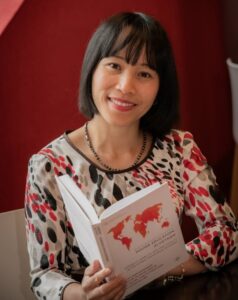
Photo: Prof. Ly Tran
The interview consists of 4 parts: m
- Australia–Vietnam Education Partnerships
- International Education as an Instrument of Public Diplomacy
- Impact Beyond Academia
- The Education–Work–Migration Nexus
VASEA: Welcome, Professor Ly Tran. Thank you for joining us for this edition of Coffee with VASEA!
Australia–Vietnam Education Partnerships
VASEA: As you may know, VASEA recently co-organised the Vietnam–Australia Forum on Science, Technology, Innovation, Education and Training. In this context, what distinguishes a sustainable education partnership from a transactional one?
Professor Ly Tran: For me, the key distinction lies in whether both sides are co-investing and learning, rather than one side primarily providing and the other simply receiving. A transactional partnership might focus on student recruitment, revenue, or a particular short-term project. Those objectives can be entirely legitimate, but they do not necessarily create sustainable relationships.
A sustainable Australia-Vietnam partnership involves shared priorities, reciprocal mobility, joint research, institutional capacity building, and relationships that continue beyond individual projects.
My work leading the Australia-Vietnam Enhanced Economic Engagement Strategy: Internationalisation of Higher Education project reflects this approach. The project is funded by the Australian Government and co-hosted with Vietnam’s Ministry of Education and Training, creating a platform for collaboration rather than simply bringing an Australian model to Vietnam.
VASEA: As you have explained, co-investment and shared learning are fundamental to a sustainable partnership. How, then, can mutuality be authentically operationalised in bilateral education strategies?
Professor Ly Tran: Mutuality needs to be built into the design of a strategy from the beginning.
It means asking not only, “What can Australia contribute to Vietnam?”, but also, “What can Australia learn from Vietnam?”, “What priorities does Vietnam identify?”, and “What capabilities can the two countries build together?”.
This approach requires shared agenda-setting, shared and empathetic leadership and, where appropriate, shared ownership of outputs and outcomes.
My Australia–Vietnam work has reinforced the importance of bringing Vietnamese and Australian colleagues together to develop resources and recommendations, rather than designing everything in Australia and simply taking it to Vietnam.
Mutuality, therefore, is not just about having partners from both countries. It is also about whose knowledge counts, who participates in decision-making, and who benefits.
International Education as an Instrument of Public Diplomacy
VASEA: Beyond its academic and economic value, international education also plays an important role in public diplomacy. In your view, how should Australia strategically use international education to strengthen its relationships with the Indo-Pacific region?
Professor Ly Tran: Australia should see international education as much more than an export industry.
Every relationship formed through international education has the potential to become a long-term relationship between people, institutions, and countries. Students who study in Australia may become future researchers, business leaders, policymakers, and community leaders. Similarly, Australian students who study in the Indo-Pacific can develop relationships and understandings that matter for Australia’s future.
My research on the New Colombo Plan has reinforced for me that student mobility can be a form of relationship-building and regional diplomacy. However, public diplomacy works best when it is based on genuine reciprocity. We should not approach the Indo-Pacific simply as a market or as a region where Australia seeks to advance its own interests.
If we want international education to strengthen Australia’s relationships with the Indo-Pacific, we need to invest in partnerships, two-way mobility, institutional collaboration, and long-term relationships.
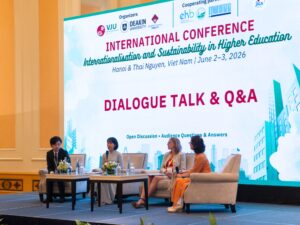
Photo: Prof Ly Tran at a conference
Impact Beyond Academia
VASEA: Professor Tran, let us turn to how academic research can directly contribute to shaping government policy. Could you share a specific example from your own research?
Professor Ly Tran: One example is my research on international student engagement. I led the Best Practice in International Student Engagement project, funded by the Australian Government. The project produced a Virtual Map and a series of Good Practice Guides for institutions supporting international students.
The important thing for me was that the research did not stop at identifying problems. We worked with students, institutions, and sector stakeholders to translate evidence into practical resources that people could actually use. I have also provided research and policy advice to the Government and sector bodies on student mobility, international education, and migration, including the New Colombo Plan, outbound student mobility, and skilled migration.
I see impact as a two-way process. Researchers bring evidence and critical perspectives, while policymakers and practitioners bring practical knowledge about what is possible. The challenge is to create something useful without losing the integrity of the research.
VASEA: For research to genuinely influence policy, scholars need to maintain a critical perspective while also considering what can realistically be implemented. How do you balance these two requirements?
Professor Ly Tran: I do not see critique and pragmatism as opposites. Good policy needs critical research because sometimes the role of a researcher is to question existing assumptions or point out unintended consequences. However, if we only criticise without considering solutions that could realistically be implemented, our influence will be limited.
My approach is to be critical about the problem but constructive about the possibilities. I try to understand the constraints and practical conditions within which policymakers and institutions are working, and then ask: given those constraints, what changes are possible? Sometimes the answer is incremental rather than transformative.
I also believe that researchers should be prepared to acknowledge when the evidence is uncertain. Policy advice should not create the impression that research can provide simple answers to complex problems. For me, maintaining research independence means being willing to challenge policy when necessary, while also engaging respectfully with those responsible for implementing it.
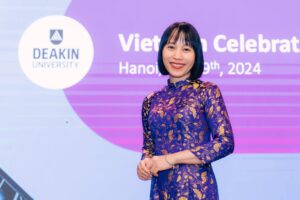
Photo: Prof. Ly Tran at Deakin University
The Education–Work–Migration Nexus
VASEA: Another important area of your research is the relationship between education, employment, and migration. In your view, where is the biggest disconnect between employability discourse and the actual employment outcomes of international graduates?
Professor Ly Tran: The biggest disconnect is that we often talk about employability as if it were entirely the responsibility of the individual student.
We encourage students to develop skills, networks, and confidence. Those things matter, but employment outcomes are also shaped by labour markets, migration policies, employer attitudes, visa conditions, discrimination, and access to professional networks.
My research on the education–work–migration nexus has led me to see employability as a relational and structural issue, not simply as a set of skills that students carry with them.
International students may graduate with strong qualifications and capabilities and still encounter significant barriers to translating those capabilities into employment opportunities.
Universities therefore need to support individual capability, but we must also acknowledge and address the structural factors that determine whether that capability can actually be converted into employment outcomes.
VASEA: International students clearly begin from different positions and have very different levels of access to resources. How can employability initiatives avoid benefiting primarily those international students who are already advantaged?
Professor Ly Tran: We need to recognise that students begin from different positions.
Some have strong English proficiency, extensive professional networks, sound financial resources, or previous work experience. Others may have very limited access to these forms of capital.
If employability programs simply provide opportunities without considering these differences, the students who already have advantages may benefit the most.
Universities therefore need to identify the barriers students face and provide differentiated support where necessary, while avoiding deficit assumptions about students’ capabilities.
We should also create opportunities for students to build social and professional networks, because employability is not only about individual skills. It is also about access to relationships and opportunities.
Coffee with VASEA: We sincerely thank Professor Ly Tran for the insights just shared—profound, practical, and truly inspiring.
