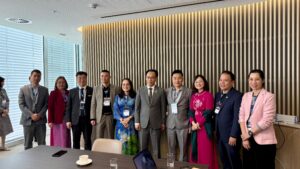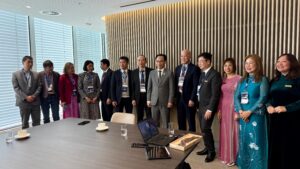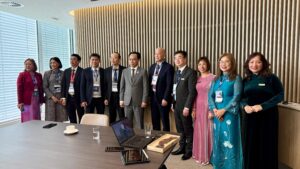
On 10 August 2026 in Sydney, the Vietnam-Australian Scholar and Experts Association (VASEA) met with Minister of Education and Training Hoang Minh Son to discuss initiatives aimed at strengthening education, research and innovation cooperation between Vietnam and Australia. The two sides also explored measures to connect with and more effectively harness the expertise of Vietnamese scholars and professionals living overseas.
At the meeting, VASEA President Professor Long Nghiem presented the Association’s major activities since its establishment, including its contribution to the organisation and delivery of the Vietnam–Australia Tech Connect Forum 2026 at the University of Technology Sydney. Organised by the Government of Vietnam with support from its Australian counterpart, Tech Connect was the first major event of the official visit by General Secretary and President Tô Lâm, aimed at strengthening Vietnam–Australia collaboration and advancing the co-development of new knowledge and technologies between the two countries.
As a grassroots organisation, VASEA has actively contributed to these important initiatives by connecting government agencies, universities, research institutions, experts and businesses, helping to foster an integrated innovation ecosystem between Vietnam and Australia.
A key achievement highlighted during the meeting was VietNEST, a digital platform developed by VASEA with financial support from the Australasian Social Impact Foundation (ASIF) to support Vietnamese-language teaching and learning for children born and raised in Australia. The platform uses artificial intelligence, games, engaging visual content and interactive activities to make learning Vietnamese more enjoyable and accessible. It also supports teachers in developing lesson plans and classroom activities, while helping students become familiar with the distinctive northern, central and southern Vietnamese accents and pronunciations.
The Minister expressed his appreciation for VASEA’s efforts in connecting educators, researchers and experts between the two countries. Minister Son also welcomed VASEA’s request for support for Phase II of VietNEST, which aims to expand its reach beyond Australia to other overseas Vietnamese communities, including New Caledonia, a French territory with special status located just over a two-hour flight from Brisbane, Australia.
People of Vietnamese descent (Người chân đăng) account for approximately 1% of New Caledonia’s population. Despite its relatively small size, the Vietnamese community in this paradise South Pacific island is vibrant and keen to preserve and express its cultural heritage and identity. Representatives of the Vietnamese community in New Caledonia have held productive discussions with VASEA on plans to adopt VietNEST, highlighting its potential to support Vietnamese language and cultural education across the wider Vietnamese diaspora. VASEA members also proposed several initiatives to strengthen cooperation between universities and experts in the two countries.
Professor Nam-Trung Nguyen, Australian Laureate Fellow, called for stronger mechanisms to engage Australian experts to work in Vietnam, noting that regulatory and foreign-interference requirements can create barriers. He encouraged a government-level dialogue to streamline arrangements and facilitate collaboration while meeting both countries’ requirements.
Participants also recommended further improving the mechanisms that enable overseas Vietnamese scholars and experts to contribute to teaching and research in Vietnam. An online platform connecting Vietnamese universities with overseas experts was identified as a practical solution for matching institutional needs with relevant expertise and collaboration opportunities.
Professor Dzung Dao – Vice President for Science and Technology Transfer – noted that some visiting professor programs in Vietnam continue to distinguish between foreign experts and Vietnamese experts residing overseas. Such a distinction could limit Vietnam’s ability to fully harness the expertise, experience, and intellectual resources of the global Vietnamese community.
Professor Tuan Anh Nguyen – Vice President for Health Science – suggested drawing on international models that not only strengthen research capacity but also develop the leadership capabilities and skills needed to cultivate the next generation of research leaders in Vietnam and across the Asia-Pacific region. He cited his initiative to establish the Asia-Pacific Brain Health Institute (APBHI), modelled on the Global Brain Health Institute, as an example.
Associate Professor Lien Duong – Vice President for ESG and Sustainability – highlighted VASEA’s unique strength in combining strong Australian networks with a deep understanding of Vietnam, enabling it to “connect two knowledge ecosystems”. Drawing on her work supporting Vietnam’s carbon market, she called for a mechanism through which the Vietnamese government could assign specific challenges or tasks to VASEA.
Ms Jane Tran – Vice President for Education, Training and International Relations – presented three proposals to harness VASEA’s expertise in education and training. First, she proposed creating opportunities for VASEA members who teach English in Australia to contribute to Vietnam’s English-language teacher training initiatives and the program to establish English as a second language in Vietnamese schools. Second, she recommended engaging VASEA’s researchers—nearly 30 per cent of its members work in academia and research—in Project 89 as potential supervisors for Vietnamese doctoral candidates. Third, she proposed establishing mechanisms for international education experts to participate in education internationalisation initiatives, helping Vietnam develop its international education sector and gradually become an international education hub in the SEA region by drawing on Australia’s experience.
Minister Hoang Minh Son welcomed VASEA’s contributions and praised the successful TechConnect Forum, noting that Vietnam’s ongoing reforms created opportunities for Vietnamese overseas scholars and experts to engage with universities and research institutions in Vietnam. He supported developing a platform to connect experts at home and abroad, with the Ministry facilitating institutional partnership. He emphasised that its success would depend on active participation and concrete collaborative programs.
The Minister said the Ministry of Education and Training had adopted a policy direction to develop a platform connecting Vietnamese scholars at home and abroad. However, the effectiveness of such a platform would depend on its ability to attract active users and generate concrete collaborative programs.
The Minister also mentioned that, with greater university autonomy, institutions can directly engage foreign and overseas Vietnamese experts, with the Ministry supporting and facilitating these connections. He encouraged VASEA to support research proposals, talent development, and help establish centres of excellence connecting leading institutions, high-performing research groups and outstanding students.
The Minister welcomed VietNEST and indicated that it would be introduced to relevant educational institutions in Vietnam, including universities specialising in social sciences and humanities. He also supported VASEA’s proposal to expand the network of English-language teachers and explore links with upcoming education programs.
The meeting opened several promising avenues for cooperation between VASEA and the Ministry of Education and Training. Through its multidisciplinary network of experts across Australia, VASEA reaffirmed its commitment to serving as a bridge for bringing international knowledge, experience and resources into education, research and innovation initiatives that contribute to Vietnam’s development.
Photos are featured in the meeting: